
Motorsports is often described as a “team sport.”
That phrase is accurate but incomplete.
Inside a professional motorsports organization, accountability is not shared equally. It is defined, assigned, and enforced with precision. Without that structure, performance collapses under ambiguity.
Understanding how accountability actually functions inside a race team reveals why some organizations improve under pressure while others fragment.
The Myth of Shared Responsibility
From the outside, it appears that wins and losses belong to everyone equally.
Internally, that is not how it works.
Every function inside a professional team carries defined ownership:
- Strategy decisions
- Setup direction
- Tire calls
- Pit execution
- Data validation
- Driver input
Each of those has a primary owner.
Collaboration informs decisions.
Ownership finalizes them.
When responsibility is unclear, performance degrades.
Role-Based Accountability
Professional teams operate on layered accountability inside a defined team structure.
Crew Chief

The crew chief carries final responsibility for race-day execution. Setup direction, strategic alignment, and adjustment approval run through this position.
Input flows upward.
Accountability rests here.
Race Engineer
The race engineer owns performance modeling, simulation interpretation, and driver communication during sessions.
If performance assumptions are wrong, this is reviewed at the engineering layer first.
Strategy
Strategy personnel own timing decisions:
- Pit windows
- Fuel projections
- Tire sequencing
- Caution response models
A strategy error is not a team error. It is a strategy function review.
Driver
The driver owns execution behind the wheel:
- Line discipline
- Tire management
- Restart positioning
- Risk calculation
Driver feedback informs setup, but driving performance remains a defined responsibility.
Data & Performance Analysis
Data engineers are accountable for validation accuracy. Incorrect data interpretation leads to incorrect decisions.
In professional environments, the review process traces outcomes back to the source layer.
Not emotionally. Structurally.
When Something Fails
Professional teams do not review failures publicly the way fans assume.
Internally, debrief structure typically follows this sequence:
- Objective outcome review
- Decision path reconstruction
- Data validation
- Assumption check
- Responsibility confirmation
The goal is not blame.
The goal is clarity.
Accountability without clarity creates instability.
Clarity without accountability creates stagnation.
Elite teams maintain both.
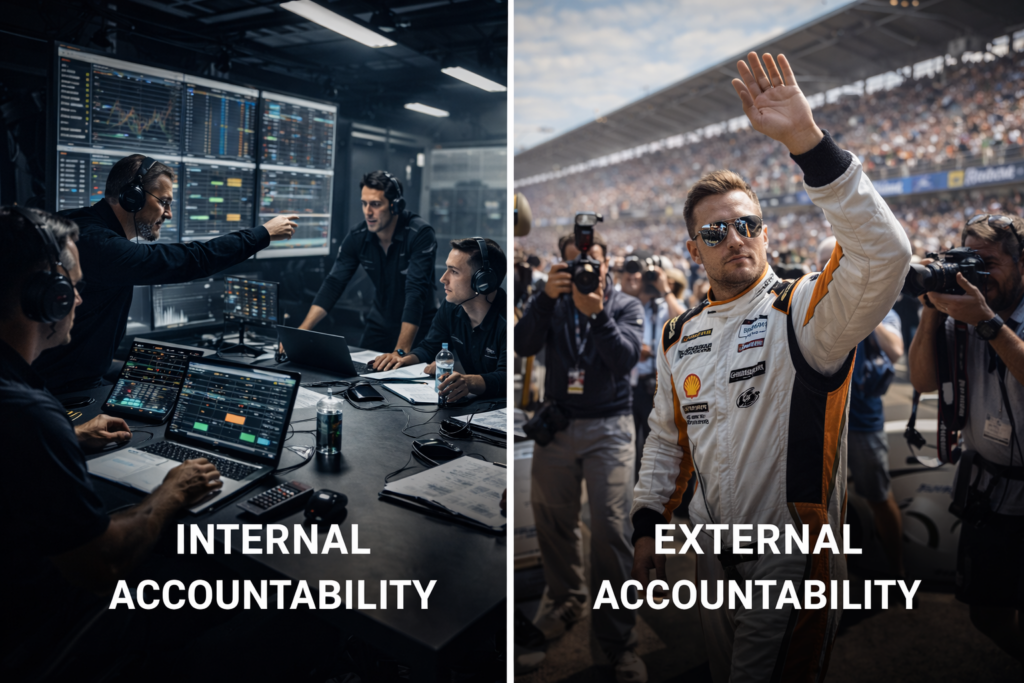
Internal vs External Accountability
Externally, messaging protects cohesion.
Internally, evaluation is direct.
Public narratives often frame outcomes as collective:
“We win together. We lose together.”
Internally, however, the review isolates:
- Where the decision was made
- What information was available
- Whether protocol was followed
- Whether judgment aligned with model
Professional motorsports operates on defined responsibility chains.
That is how improvement compounds.
Why Accountability Structure Matters
When accountability is clear:
- Decision speed increases
- Emotional reaction decreases
- Performance variance narrows
- Team trust strengthens
When accountability is vague:
- Meetings become defensive
- Information flow tightens
- Risk avoidance replaces optimization
Accountability is not about discipline.
It is about performance architecture.
The Structural Triangle
In high-performing teams, three systems operate together: information flow, decision authority, and accountability.
- Information Flow
- Decision Authority
- Accountability
Remove one, and the system weakens.
Accountability is the stabilizer.
Without it, performance becomes circumstantial instead of repeatable.
Professional motorsports teams are not defined by passion alone.
They are defined by structure.
Accountability is one of the clearest indicators of competitive maturity.