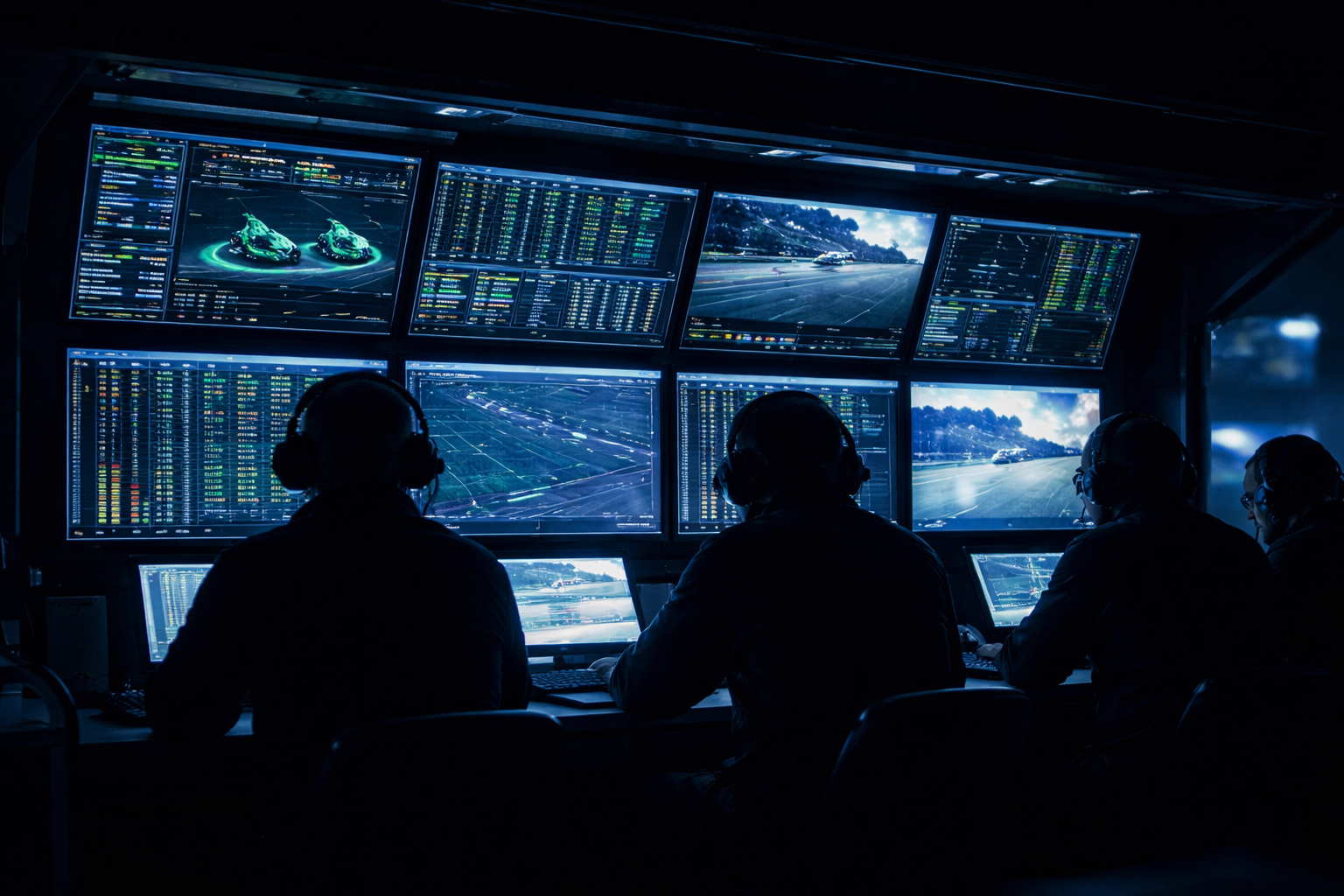
Modern motorsports teams are not driven by speed alone. They are driven by information.
Authority determines who acts.
Workflow determines who does what.
But information flow determines what is even possible to act on.
Understanding how information actually moves through a race team clarifies why certain roles exist, why others filter rather than decide, and why not all data reaches the final call.
Information Is Generated Everywhere
Information inside a motorsports team originates from multiple sources at once:
- Car telemetry
- Driver feedback
- Environmental sensors
- Timing and scoring systems
- Competitor performance
- Tire data
- Fuel modeling
- Video and radio communication
None of these sources operate sequentially. They operate simultaneously.
The volume alone makes it impossible for any single role to process everything in real time.
That is why teams do not “collect data.”
They structure it.
Raw Data Is Not Usable Information
Telemetry streams are continuous.
They are not insight.
Before information moves toward authority, it passes through interpretation layers:
- Data capture
- Validation
- Filtering
- Context alignment
- Communication
The Data Engineer manages signal integrity and ensures reliability.
The Performance Engineer contextualizes performance relative to baseline.
The Race Engineer translates technical signals into actionable language for the driver.
Each layer reduces noise.
Information does not move upward.
It narrows.

Compression Is the Hidden Function
During live competition, time is constrained. Bandwidth is constrained. Cognitive load is constrained.
Information must be compressed before it reaches the pit wall.
Instead of:
- 200 telemetry channels
- Multiple delta comparisons
- Degradation curves
What reaches the final layer is often:
- “Tire temp trending high.”
- “Fuel number marginal.”
- “Rear instability increasing.”
That compression is not simplification.
It is structured prioritization.
Teams are not optimizing for completeness.
They are optimizing for relevance under time pressure.

Not All Information Moves
An important but rarely discussed reality:
Most information never reaches authority.
It is filtered out because:
- It does not change outcome probability
- It falls within acceptable variance
- It introduces unnecessary noise
- It conflicts with established model confidence
This filtering is intentional.
Information flow inside a race team is not democratic.
It is selective.
Direction of Flow Is Not Always Upward
Information does not only move toward authority.
It also moves:
- From engineer to driver
- From driver to engineer
- From strategist to operations
- From operations back to engineering
The structure is circular, not vertical.
Authority exists within this system, but it does not sit at the top of a pyramid. It sits at control points within a loop.
Understanding this loop clarifies why the “final call” is only one moment within a much larger movement of signal.
Information vs Authority
Information flow and authority are related but not identical.
Information answers:
- What is happening?
- What is changing?
- What is trending?
Authority answers:
- Do we act?
- Do we wait?
- Do we override?
Without structured information flow, authority operates blindly.
Without defined authority, information stagnates.
The two systems must function independently and cohesively.
Why This Matters
Many observers assume race teams operate through constant open communication.
They do not.
They operate through:
- Structured filtering
- Controlled communication
- Defined translation layers
- Prioritized signal movement
This architecture is what allows a team to function under high-speed, high-risk conditions without chaos.
Understanding how information moves reveals how teams maintain clarity when everything around them is accelerating.