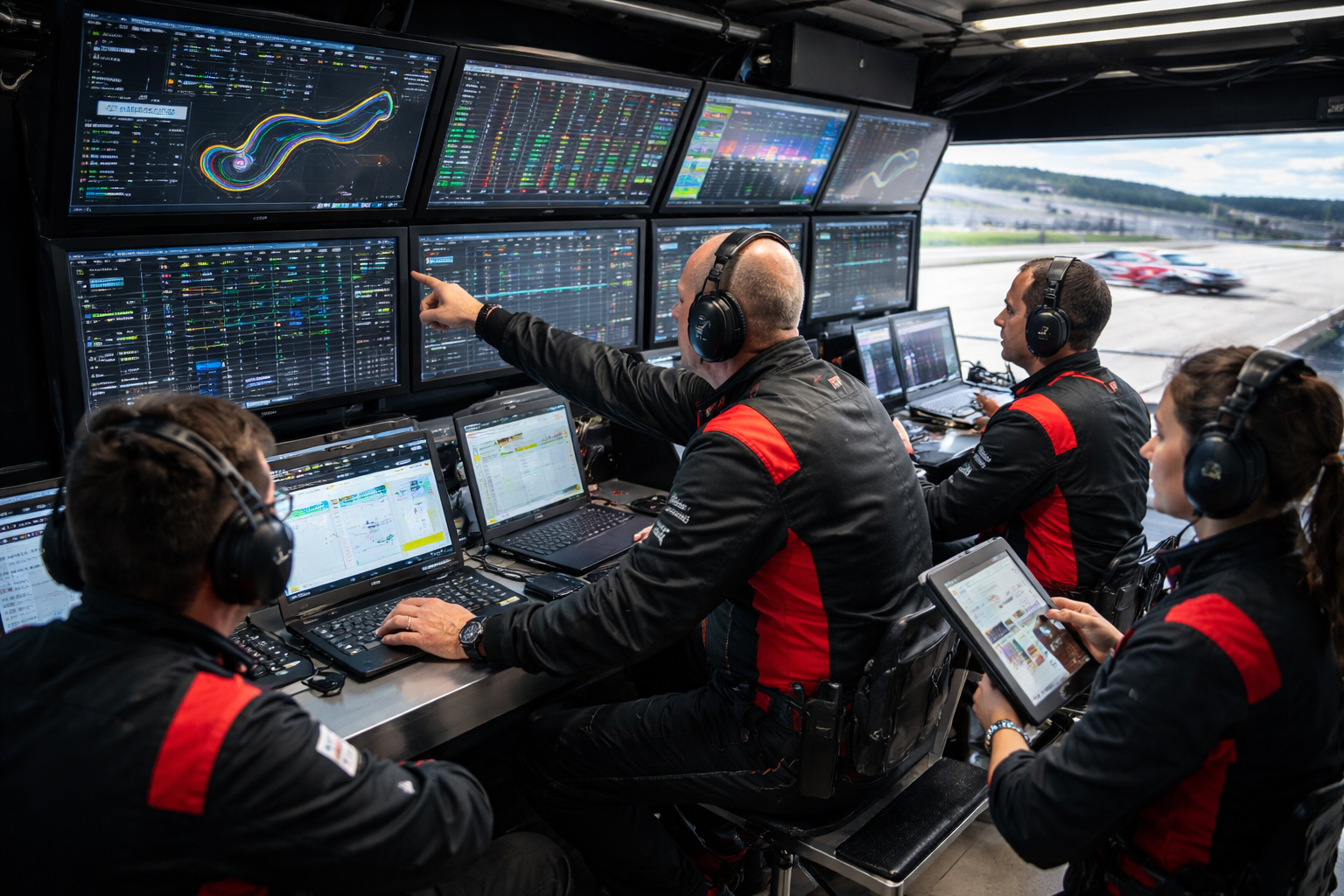
Motorsports decisions are often described as fast, high-pressure, and data-driven. While all of that is true, it can obscure how decisions are actually made inside a professional race team. Very few calls come from a single person, and almost none are made in isolation.
Instead, race-weekend decisions emerge from layered inputs, defined responsibilities, and structured communication between technical, operational, and strategic roles. Understanding this process is essential for anyone looking to work inside a motorsports team, whether as an engineer, strategist, operations manager, or support specialist.
This article breaks down how motorsports teams make decisions across a race weekend and how those decisions flow through the organization.
Decision Layers Inside a Motorsports Team
Every professional motorsports team operates with multiple decision layers. These layers exist to manage complexity, time pressure, and risk.
The primary layers are:
- Strategic decisions
Long-range choices that define race approach and objectives. - Technical decisions
Car setup, performance tradeoffs, and engineering adjustments. - Operational decisions
Logistics, timing, execution, and resource coordination. - Communications decisions
Information flow internally and externally.
Each layer has authority in specific areas. Problems arise when responsibilities overlap or when information does not reach the right layer at the right time.
Decisions Made Before the Event
Many of the most important decisions happen before the car ever arrives at the circuit.
Pre-event decisions typically include:
- Setup direction and philosophy
- Simulation targets and performance assumptions
- Strategy ranges (fuel windows, tire plans, pit stop flexibility)
- Logistics constraints and staffing plans
By the time a race weekend begins, teams are no longer deciding what they want to do. They are refining how closely reality matches expectations.
These early decisions reduce uncertainty later and give teams a structured framework for reacting to changing conditions.
Practice Sessions: Validation and Adjustment
Practice sessions are not about chasing lap time alone. They exist to validate assumptions made during preparation.
Key decisions during practice include:
- Whether setup direction matches driver feedback
- Which performance trends are real versus session-specific
- How environmental conditions affect baseline plans
Engineers and drivers work together to identify patterns rather than one-off results. Changes made during practice are often conservative, focused on consistency rather than outright speed.
Decisions at this stage are collaborative and deliberately cautious.
Qualifying: Narrowing the Window
Qualifying compresses decision-making into a smaller time window. Risk tolerance increases, and margins shrink.
During qualifying, teams decide:
- How aggressively to chase peak performance
- Whether to prioritize track position or tire preservation
- How much setup compromise is acceptable for race conditions
Unlike practice, qualifying decisions tend to be more centralized. Engineers and strategists align quickly, and execution becomes the priority.
Mistakes here are costly, but over-reacting can be just as damaging.
Race Day: Decision Flow Under Pressure
Race day decisions are where the full structure of the team becomes visible.
No single role “runs the race.” Instead, decisions flow between groups:
- Driver feedback informs grip, balance, and car behavior.
- Engineers translate that feedback into actionable adjustments.
- Strategists manage timing, pit windows, and scenario modeling.
- Operations staff ensure execution matches the plan.
Each group controls a specific domain. Clear boundaries prevent confusion when conditions change rapidly.
The most effective teams are not the fastest to react, but the most disciplined in how decisions are escalated and approved.
Data Versus Judgment
Modern motorsports relies heavily on data, but data does not replace human judgment.
Data is strongest when:
- Confirming trends across multiple laps
- Supporting strategic probability models
- Identifying performance degradation or anomalies
Judgment becomes critical when:
- Data is incomplete or delayed
- Conditions change faster than models can adapt
- Human factors override numerical optimization
Experienced teams understand when to trust numbers and when to rely on experience. Poor decision-making often comes from overconfidence in one at the expense of the other.
Time Pressure and Tradeoffs
Race-weekend decisions rarely have perfect answers. Teams operate under time pressure, incomplete information, and competing objectives.
Common tradeoffs include:
- Track position versus tire life
- Aggressive strategy versus risk exposure
- Short-term gain versus long-term race outcome
Good decisions are not judged solely by results. They are judged by whether they were reasonable given the information available at the time.
This mindset allows teams to improve processes instead of assigning blame.
How Roles Interlock
Understanding how roles connect is essential for anyone entering motorsports.
Examples of interlocking responsibilities:
- Race Engineers translate driver input into technical direction.
- Performance Engineers evaluate data trends and performance tradeoffs.
- Data Engineers ensure accurate, timely data flow to decision-makers.
- Team Operations Managers coordinate timing, resources, and execution.
- PR and Communications manage information consistency and external messaging.
No role operates independently. Successful teams value clarity, handoffs, and trust between disciplines.
Why This Matters for Motorsports Careers
Teams do not hire based solely on technical skill. They hire people who understand decision flow.
Professionals who understand how decisions are made:
- Communicate more effectively
- Anticipate constraints and priorities
- Reduce friction between departments
- Become trusted contributors faster
For anyone pursuing a motorsports career, understanding decision-making structure is as important as mastering tools or technical knowledge.
Final Thoughts
Motorsports decision-making is structured, layered, and deliberate. While races are unpredictable, the process behind decisions is not improvised.
Teams succeed by preparing early, defining responsibilities clearly, and balancing data with experience. Those who understand this process are better equipped to contribute meaningfully inside a race organization.