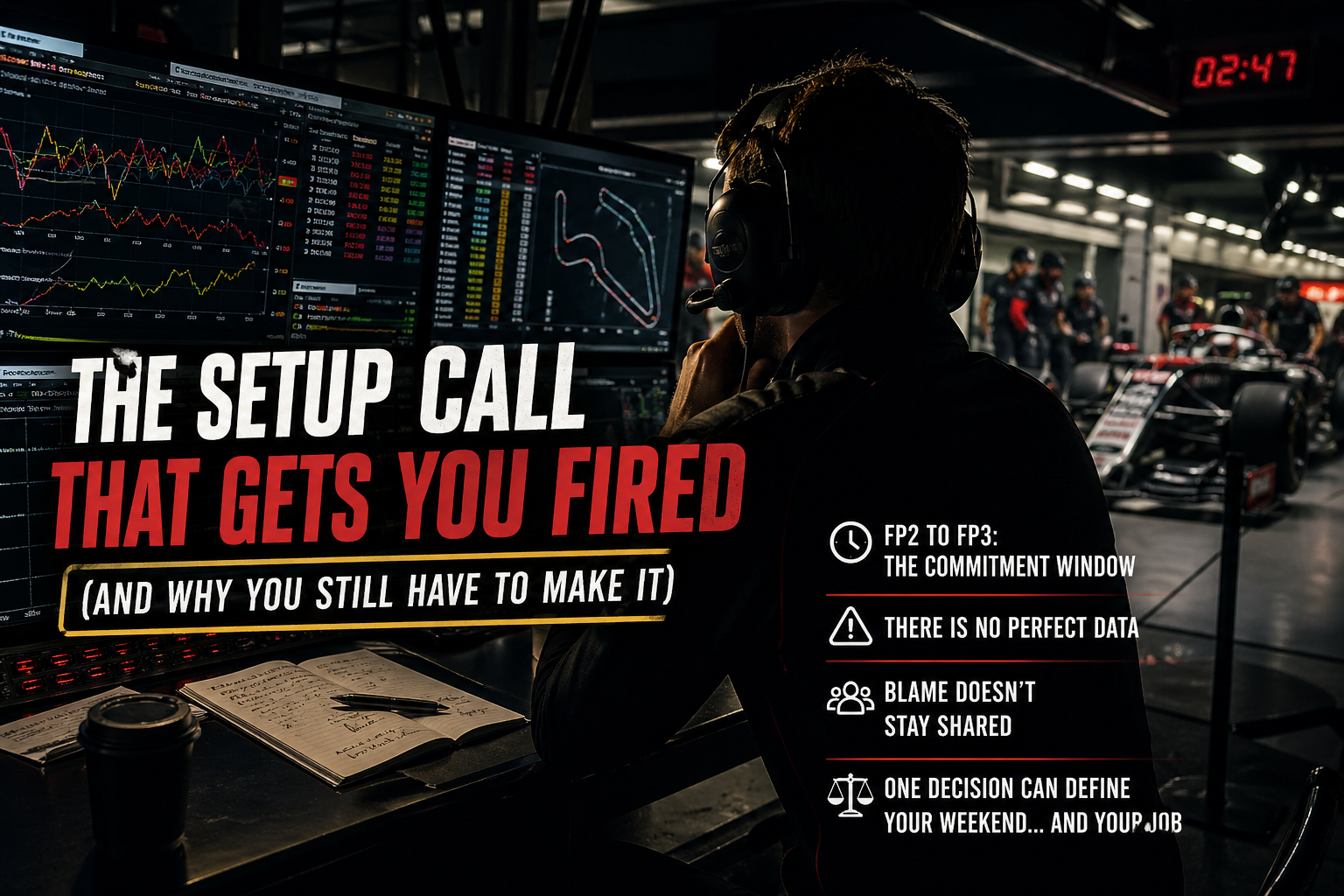
The most important decisions in motorsport aren’t made when you’re confident.
They’re made when you’re out of time.
And if you get it wrong, everyone will tell you later that it was obvious.
FP2 Is Where the Weekend Is Won or Lost
Most people think the race is decided on Sunday.
It’s not.
It’s decided somewhere between the last run in FP2 and the first run in FP3.
That’s where you stop exploring and start committing.
And here’s the truth most won’t say out loud:
If you commit in the wrong direction here, your weekend is already damage control.
You can dress it up with strategy.
You can try to manage it with tire calls.
But you’re not fixing it.
You’re surviving it.
“We Need More Data” Is Usually a Lie
There’s this idea that more laps = better decisions.
It sounds right.
It’s wrong.
Every additional run comes with tradeoffs:
- Different track conditions
- Tire state that doesn’t match race conditions
- Driver adapting to the car instead of exposing it
At some point, more data doesn’t clarify the decision.
It delays it.
And delaying the decision is how you end up committing too late.
Most Teams Don’t Commit – They Drift
This is where weekends quietly fall apart.
No one makes a clear call.
Instead, adjustments get smaller.
Changes get safer.
Direction gets blurred.
You end up with a car that isn’t:
- fast enough for qualifying
- stable enough for the race
And everyone says the same thing after:
“We just never quite got on top of it.”
No.
You never committed.
This is where role clarity breaks down — something explored deeper in the race engineer vs performance engineer comparison and how decisions actually get made under pressure.
Driver Confidence Is Overvalued (Sometimes)
Every engineer says the same thing:
“We prioritize driver confidence.”
Sounds right. Safe. Professional.
But here’s the problem:
If you’re sacrificing too much performance for comfort, you’re not managing the weekend.
You’re conceding it.
There are situations where the driver needs to adapt to the car.
Not the other way around.
And yes that’s where relationships get tested, especially in the tension between the race engineer vs performance engineer comparison, where data and driver feel don’t always align.
The Scenario No One Agrees On
Low grip track. Rear instability on entry.
The driver wants security.
Data shows there’s still front-end potential in the car.
So what do you do?
- Stabilize the rear → gain confidence, lose rotation
- Push front end → gain pace, risk overdriving
There is no correct answer.
But there is a consequence.
And whichever direction you choose, someone in the garage thinks you made the wrong call.
The Biggest Mistake Isn’t the Setup
It’s chasing it too long.
You miss the commitment window.
You keep adjusting.
You keep searching.
And suddenly FP3 becomes your test session.
Now you’re not refining.
You’re guessing.
That’s how weekends disappear without a clear failure point.
Blame Doesn’t Stay Shared
Inside the garage, decisions are collaborative.
Until they’re wrong.
Then it gets very simple, very fast.
Who made the call?
And proximity matters.
The closer you are to the driver…
The closer you are to that decision…
The more it sticks to you.
Fair or not.
You’re Not Paid to Be Right
This is the part most people don’t understand.
The job isn’t to always make the correct decision.
That’s impossible.
The job is to:
- Make the call with incomplete information
- Make it at the right time
- Own it when it doesn’t work
Because hesitation costs more weekends than bad decisions ever will.
So Here’s the Question
At the end of FP2…
You don’t have a complete picture.
You never do.
Do you:
- commit early and risk being wrong
- or wait longer and risk never committing at all
Because one of those loses you the weekend.
The other just tells you how.