Motorsport loves certainty.
We celebrate decisive drivers.
We praise fearless strategy calls.
We admire engineers who appear completely in control.
But certainty has destroyed more race weekends than uncertainty ever has.
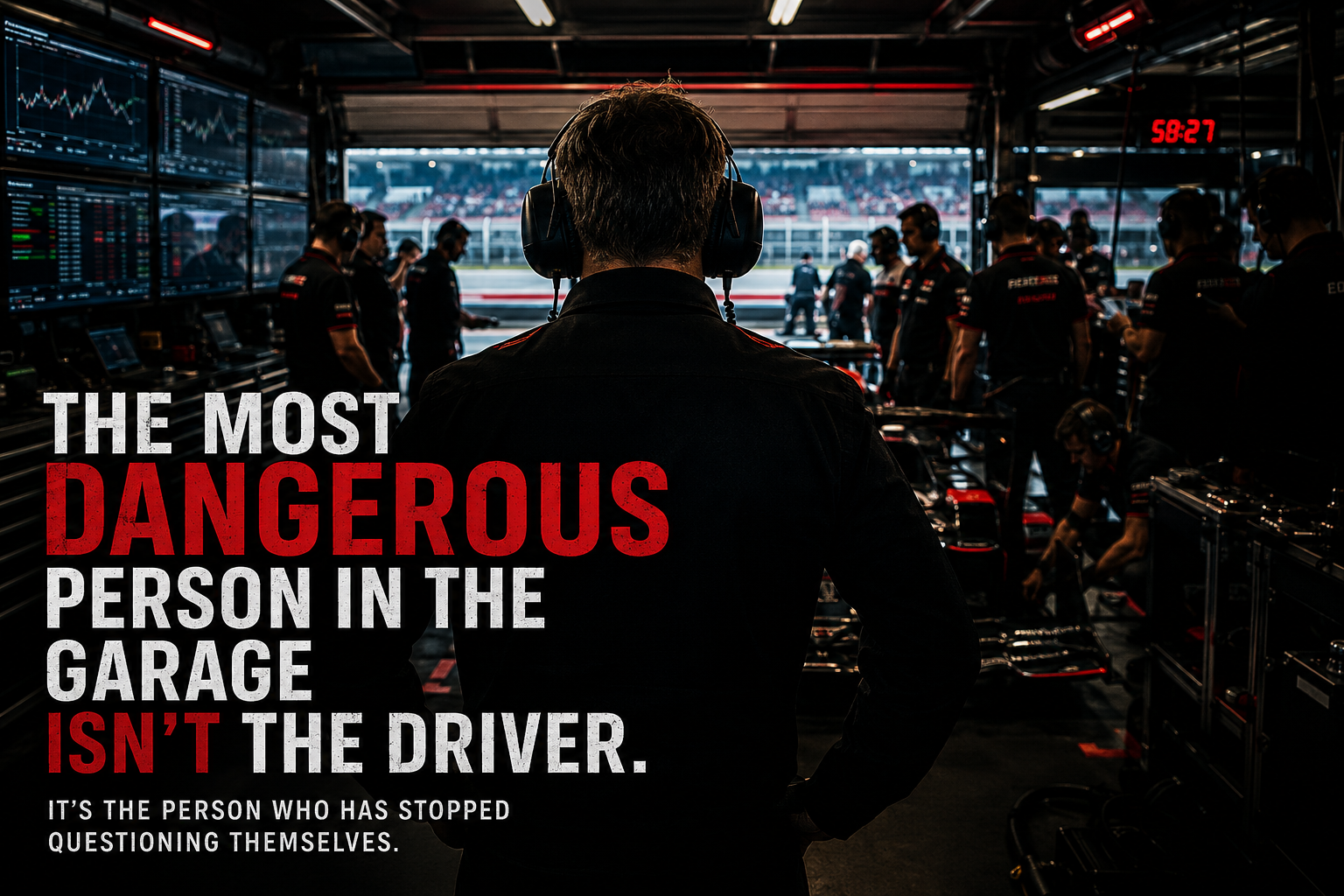
The most dangerous person in the garage isn’t the driver who overdrives the car.
It isn’t the rookie who lacks experience.
It isn’t the mechanic who misses a setup change.
It’s the person who stops questioning themselves.
That person can be anyone.
A race engineer.
A chief engineer.
A performance engineer.
A technical director.
A team principal.
Experience isn’t what makes them dangerous.
Believing experience makes them incapable of being wrong does.
Confidence Wins Races. Certainty Loses Them.
There is a difference.
Confidence allows you to make a difficult decision with incomplete information.
Certainty convinces you there is no other decision worth considering.
One adapts.
The other defends.
One listens.
The other waits for everyone else to stop talking.
Every successful engineer has confidence.
The best engineers never mistake that confidence for infallibility.
The Warning Signs Rarely Show Up in the Data
Telemetry doesn’t tell you someone has stopped listening.
Simulation doesn’t reveal an engineer who has become emotionally invested in a setup direction.
Performance reports don’t measure confirmation bias.
The warning signs are human.
Driver feedback is dismissed before it’s fully explained.
Alternative setup directions are rejected because “we’ve already tried that.”
Young engineers stop offering ideas because experience always wins the argument.
Eventually the garage becomes quiet.
Not because everyone agrees.
Because disagreement has become pointless.
Most teams never recognize this moment.
They simply wonder why development slows.
Every Bad Weekend Starts With a Good Reason
Nobody wakes up intending to make the wrong decision.
Every failed race weekend begins with logic.
“We know this circuit.”
“The simulator supported it.”
“The numbers were clear.”
“We’ve always gone this direction.”
Each statement sounds reasonable.
Until the track proves otherwise.
The danger isn’t making the wrong call.
The danger is refusing to believe the evidence after the first five laps tells you the call was wrong.
That refusal costs more positions than the original mistake.
The Driver Isn’t Always Right
Let’s challenge another assumption.
Drivers can be wrong.
Sometimes spectacularly wrong.
They’ll chase a balance problem that doesn’t exist.
They’ll blame rear grip for an issue caused by braking technique.
They’ll ask for a setup change that solves one corner while destroying the other twelve.
Experienced engineers know this.
But here’s the uncomfortable question.
How often is the engineer just as guilty?
How often does an engineer defend a setup because admitting it isn’t working means admitting the original decision was wrong?
Motorsport is full of conversations about driver ego.
It spends far less time discussing engineering ego.
Maybe it should.
The Cost of Being the Smartest Person in the Room
Every team has someone everyone trusts.
That’s earned.
But trust carries a hidden danger.
Eventually people stop challenging the trusted voice.
The room becomes efficient.
Meetings become shorter.
Decisions come faster.
And blind spots grow larger.
Because intelligence doesn’t eliminate bias.
Experience doesn’t eliminate bias.
Success doesn’t eliminate bias.
Sometimes it reinforces it.
The most dangerous sentence in motorsport isn’t:
“I don’t know.”
It’s:
“I’ve seen this before.”
Maybe you have.
Or maybe you’re forcing today’s problem to fit yesterday’s solution.
Data Doesn’t Remove Bias
Teams love saying they’re data driven.
Every team is.
Until the data disagrees with the plan.
Then something interesting happens.
One graph gets ignored.
Another gets emphasized.
One driver comment becomes “subjective.”
Another becomes “valuable.”
The numbers haven’t changed.
Only the interpretation has.
Data doesn’t make decisions.
People do.
And people bring pride, pressure, reputation, politics, and emotion into every meeting.
Pretending otherwise is one of the biggest lies in modern motorsport.
The Most Expensive Mistakes Are Quiet
Spectacular failures are easy to identify.
A strategy disaster.
A mechanical failure.
A pit stop that costs ten seconds.
Those become headlines.
The dangerous mistakes rarely do.
A setup direction that was never challenged.
A concern never raised because someone didn’t want to contradict the lead engineer.
A driver who stopped giving honest feedback because nobody listened anyway.
Those moments never appear on television.
But they shape entire seasons.
Great Teams Don’t Avoid Conflict
They invite it.
The strongest engineering rooms aren’t the quietest.
They’re the loudest.
Not because people are fighting.
Because ideas are.
The best race engineers don’t surround themselves with agreement.
They surround themselves with people willing to prove them wrong before the circuit does.
That’s not weakness.
That’s competitive advantage.
If everyone leaves a setup meeting agreeing with every decision, someone probably stopped asking difficult questions.
Here’s the Question Every Garage Should Ask
Before qualifying…
Before the race…
Before the strategy meeting ends…
Ask one question.
“What evidence would convince us we’re wrong?”
If nobody has an answer…
You no longer have an engineering discussion.
You have a belief system.
And belief systems don’t win races.
They defend themselves.
The Most Dangerous Person in the Garage
So who is the most dangerous person in the garage?
It isn’t the driver chasing another tenth.
It isn’t the rookie making their first mistake.
It isn’t the mechanic learning under pressure.
It’s the person whose opinion has become more valuable than evidence.
The person who has stopped listening because they believe experience has replaced curiosity.
Every championship team has brilliant people.
That isn’t the difference.
The difference is whether those brilliant people still allow themselves to be challenged.
Because the day nobody is willing to question the smartest person in the room…
…is usually the day the competition starts catching you.
Now the debate belongs to you.
What’s more dangerous in a race garage: an inexperienced engineer willing to learn, or a successful engineer who believes they’ve already learned enough?