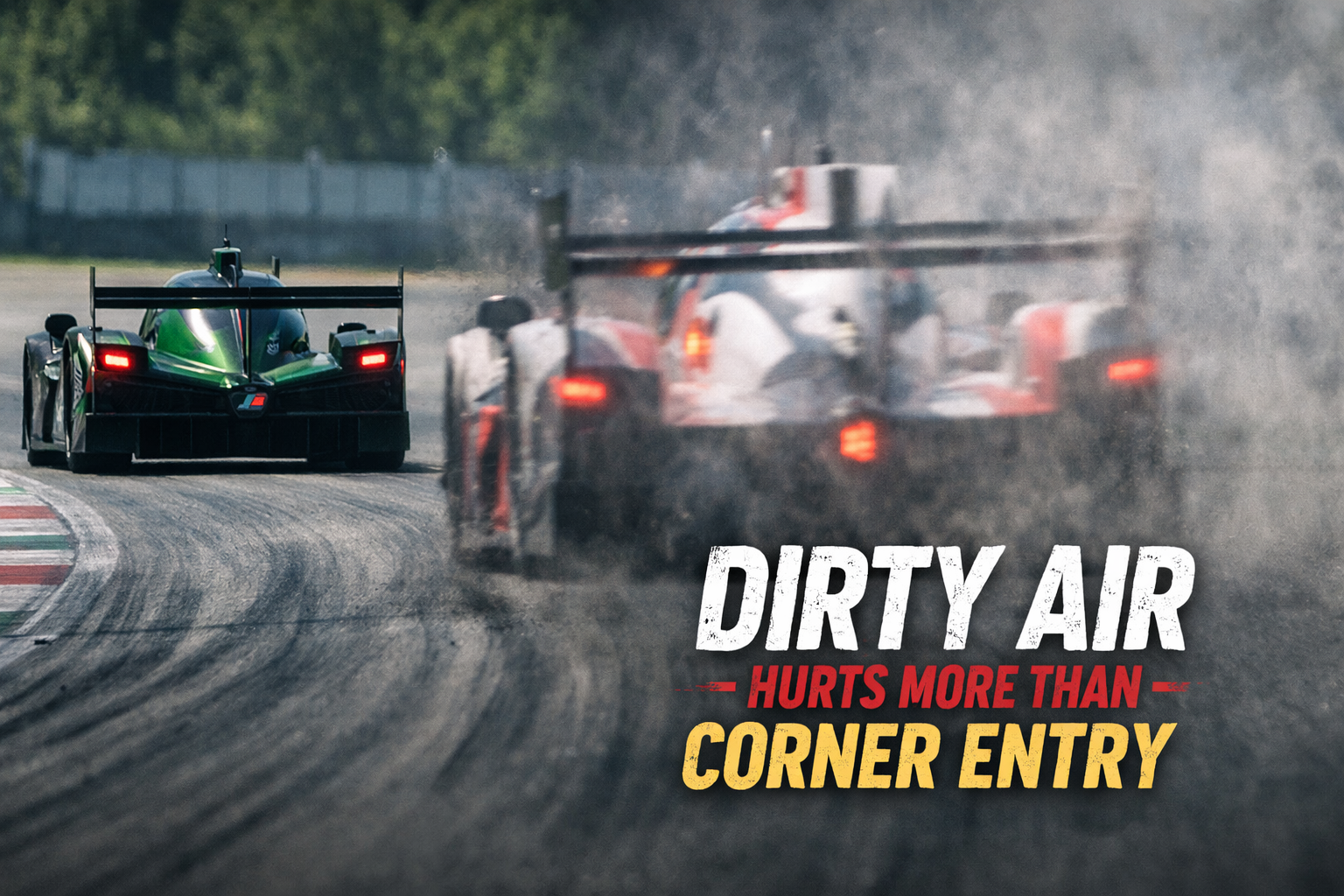
Dirty air is usually described as a front-end problem.
You lose front load.
The car won’t rotate.
Mid-corner understeer increases.
That explanation is convenient.
It’s also incomplete enough that it leads teams in the wrong direction.
When a car runs in disturbed air, the issue is not simply a reduction in peak downforce.
It’s a degradation in aero stability.
The flow field the car is designed to operate in no longer exists.
Instead of clean, attached flow structures feeding the floor, diffuser, and rear wing, the car is now ingesting:
- lower-energy airflow
- increased turbulence intensity
- non-uniform pressure distribution across the aero surfaces
This doesn’t just reduce load.
It makes load less predictable.
That distinction matters.
Because drivers don’t react to peak grip.
They react to consistency of response.
In clean air, the car produces load in a way that is repeatable corner to corner.
Ride height changes, yaw, and steering input all map to expected behavior.
In dirty air, those relationships break down.
The front wing may lose efficiency, but more importantly:
- the floor sees disrupted sealing
- the diffuser loses extraction consistency
- rear load becomes more sensitive to small changes in attitude
Now the platform is no longer stable.
This is where the common narrative fails.
The driver reports understeer.
The team adds front.
But the primary issue is not front load deficiency.
It’s that the front and rear are no longer moving together in a predictable way.
The result is not just push.
It’s inconsistency through the phase of the corner.
On entry, the car may feel reasonable.
Mid-corner, the aero platform shifts as ride height and yaw evolve.
On exit, the rear may regain load in a way that is delayed or nonlinear.
Two laps can look similar in data.
But the driver is managing a car that is no longer behaving on a stable curve.
At the same time, secondary systems begin to degrade.
Cooling is one of the least discussed but most relevant factors.
Disturbed airflow reduces mass flow through heat exchangers.
That has cascading effects:
- coolant temperatures rise, forcing lift or power management
- brake temperatures become less consistent due to reduced duct efficiency
- intake air conditions change, affecting engine performance and calibration margins
None of these present as a single failure.
They show up as constraints.
The driver starts managing limits that were not present in clean air.
This is why the lap time loss often appears gradual.
It’s not a single deficit.
It’s multiple small degradations stacking:
- reduced aero efficiency
- increased sensitivity to platform movement
- thermal limitations requiring intervention
- higher driver workload to maintain consistency
By the time the loss is visible in lap time, the car has already been operating outside its optimal state for multiple laps.
This is also why setup changes often fail to solve the problem.
When teams add front wing or adjust mechanical balance, they are trying to compensate for a condition that is not intrinsic to the car.
The moment the car returns to clean air, those changes can push it out of its optimal range.
Now the car is compromised in both conditions.
Strong teams treat dirty air as a different operating state, not just a degraded version of the same one.
They recognize that:
- aero maps in traffic are not the same as in clean air
- balance complaints may be symptoms of instability, not static imbalance
- performance limitations may be driven by thermal constraints as much as grip
And most importantly:
Not every problem in traffic should be solved with setup.
Dirty air is not just a loss of front grip.
It is a loss of coherence in how the car generates performance.
And if that distinction isn’t made, the response will always target the wrong cause.
Which is why so many adjustments made in traffic don’t just fail to help.
They create a new problem the moment the air is clean again.