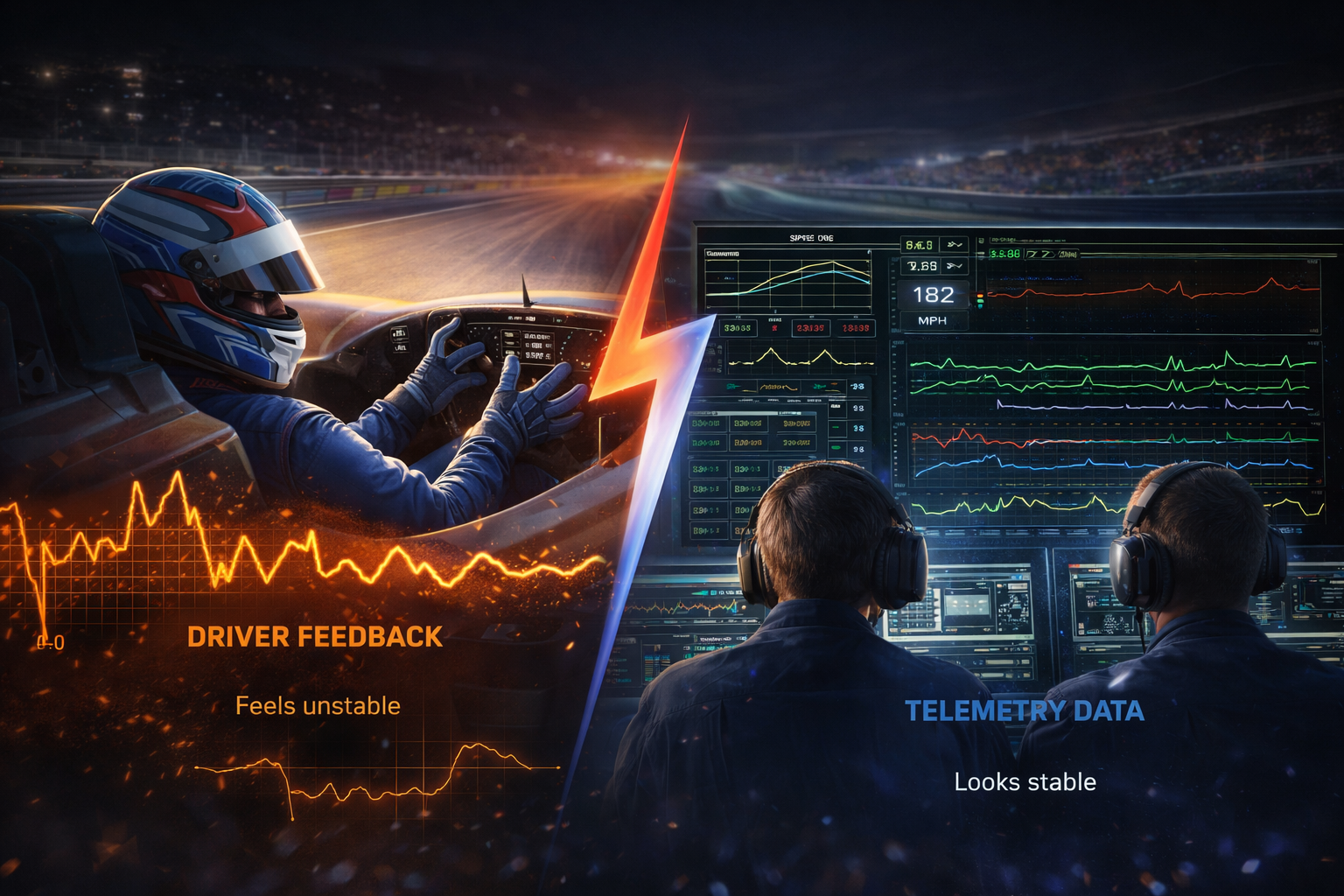
The Conflict Between Feel and Data
Inside a race team, one of the most common points of tension is simple:
The driver says one thing.
The data says another.
A driver may report understeer on corner entry.
Telemetry may show minimum speed and steering input that suggest the car is stable.
Both can be correct.
This is where engineering judgment matters.
Drivers Experience the Limit Differently
Drivers do not feel the car as a set of numbers.
They feel:
initial bite on turn-in
rear stability under braking
rotation mid-corner
traction on exit
These sensations are shaped by how quickly forces build and release, not just the final outcome.
Two laps with identical telemetry traces can feel completely different to a driver depending on how the car transitions between phases.
Telemetry Shows Outcomes, Not Always Causes
Telemetry is powerful, but it has limitations.
It shows:
speed
steering input
throttle position
brake pressure
lateral and longitudinal forces
What it does not always show clearly is how those forces developed.
A car that snaps into oversteer and a car that gradually rotates may produce similar data traces.
But the driver experiences them very differently.
The Role of Vehicle Dynamics
This is where vehicle dynamics becomes critical.
Engineers analyze:
load transfer rates
suspension response
aerodynamic stability under pitch
tire load sensitivity
These factors explain why the car feels unstable even when the data looks acceptable.
Without this layer of analysis, teams risk dismissing valid driver feedback.
When Data Is Trusted Too Much
Teams that rely too heavily on data can miss early signs of instability.
A driver may begin to lose confidence before lap time drops.
If that feedback is ignored because the data appears “normal,” the problem often grows worse over a run.
By the time lap time reflects the issue, the opportunity to correct it early has already passed.
When Drivers Misinterpret the Car
The opposite problem also exists.
Drivers can misattribute the cause of a balance issue.
For example:
rear instability may be caused by front-end limitations
corner exit issues may originate from entry balance
tire degradation may be mistaken for setup problems
This is why data analysis remains essential.
Where Good Teams Get It Right
Strong teams do not choose between driver feedback and data.
They combine them.
The race engineer translates driver input.
The performance engineer validates trends.
Vehicle dynamics explains the underlying behavior.
When these layers align, decisions become clearer and more effective.
Why This Still Matters at the Highest Level
Even at the top levels of motorsport, this conflict never disappears.
Drivers and engineers are constantly interpreting incomplete information under time pressure.
The teams that manage this process best are not the ones with the most data.
They are the ones that understand how to interpret it alongside what the driver feels.
The Real Objective
The goal is not to prove the driver right or the data right.
The goal is to understand the car.
Because when understanding improves, performance follows.