Why Vehicle Dynamics Matters in Racing
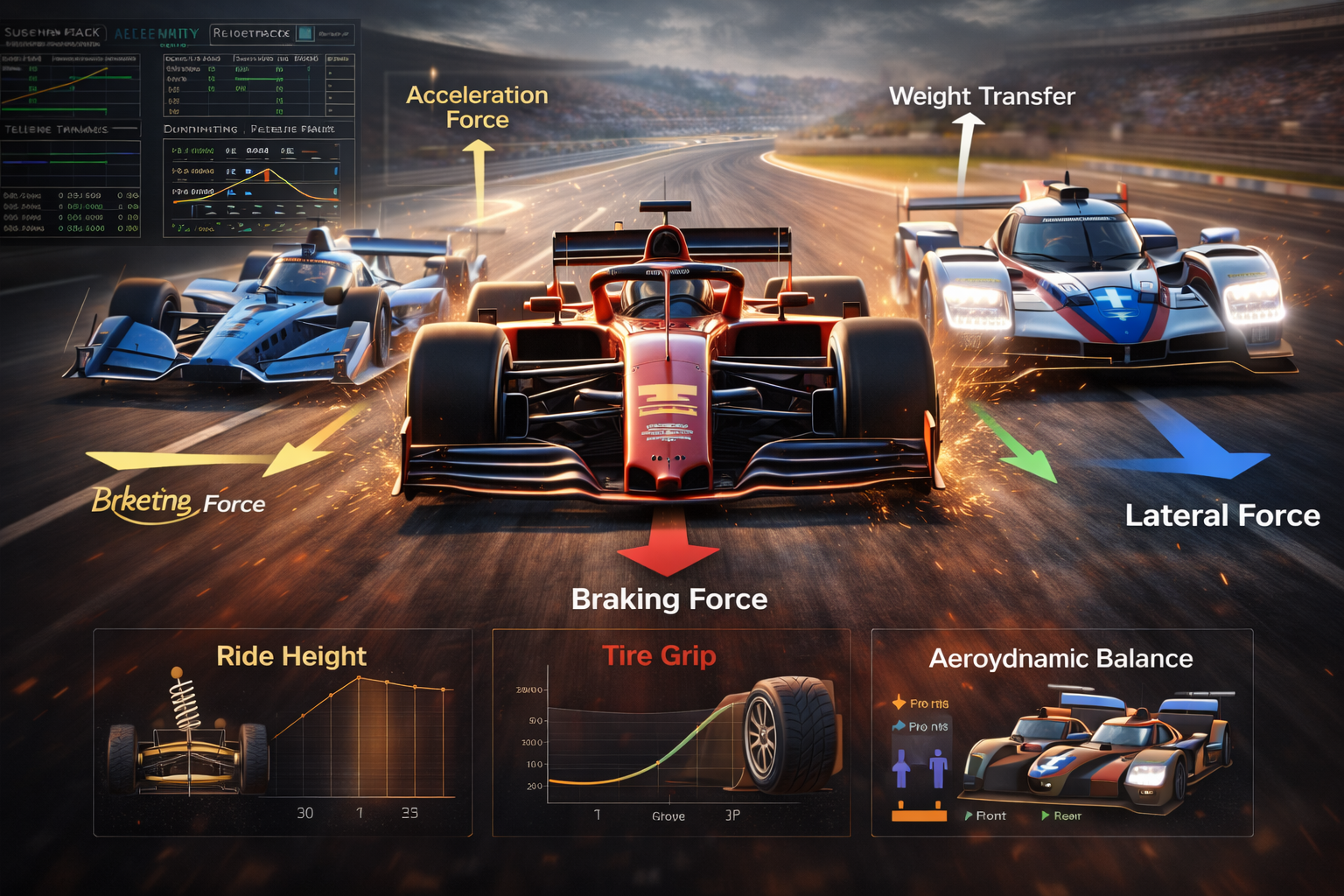
In motorsport, vehicle dynamics refers to how forces act on a race car as it accelerates, brakes, and corners. These forces determine how the car transfers weight, maintains tire grip, and responds to driver inputs at speed.
While lap time ultimately determines performance, the forces controlling the car’s behavior often reveal the real story behind that performance. Vehicle dynamics focuses on understanding these forces and how they interact with suspension design, tire behavior, aerodynamic load, and chassis balance.
Engineers use vehicle dynamics analysis to understand why a car behaves the way it does and how small changes can alter the balance drivers feel on track.
The Four Core Forces Acting on a Race Car
Vehicle dynamics analysis begins with the forces acting on the car during a lap.
These forces include:
Acceleration forces when the driver applies throttle
Braking forces when the driver decelerates into corners
Lateral forces generated while cornering
Vertical load forces acting through the suspension and tires
Each of these forces changes how weight moves across the chassis.
Managing those forces correctly allows the tires to maintain grip throughout the lap.
Weight Transfer and Car Balance
One of the most important concepts in vehicle dynamics is weight transfer.
When a car brakes, weight moves toward the front tires.
When it accelerates, weight shifts toward the rear.
During cornering, weight moves toward the outside tires.
These changes influence how much grip each tire can produce.
Vehicle dynamics engineering studies how suspension design, spring rates, and damping control these shifts so the car remains balanced under load.
Tires and the Contact Patch
The tire contact patch is where the car meets the track surface.
Vehicle dynamics analysis focuses heavily on how load moves through this small patch of rubber.
Engineers evaluate:
tire load sensitivity
temperature distribution
slip angle behavior
pressure growth across a run
If loads move outside the tire’s optimal range, grip falls quickly.
Maintaining stable tire loading is therefore one of the central goals of race car setup.
Aerodynamic Balance and Platform Control
Modern race cars rely heavily on aerodynamic downforce.
Vehicle dynamics engineers study how the aerodynamic platform behaves as the car moves through braking zones, corners, and acceleration phases.
Changes in ride height, pitch angle, or suspension compression can alter the aerodynamic balance between the front and rear of the car.
Maintaining platform stability allows aerodynamic forces to remain predictable across the lap.
Why Small Setup Changes Have Large Effects
Race cars operate very close to the limit of tire grip and aerodynamic stability.
Because of this, even small setup adjustments can significantly alter how the car behaves.
Examples include:
minor ride height adjustments
small damping changes
subtle aerodynamic balance shifts
These changes influence how load moves across the chassis and how the tires respond during a lap.
Vehicle dynamics analysis helps engineers understand these interactions before they affect lap time.
Vehicle Dynamics Across Different Motorsport Series
Vehicle dynamics principles apply across all major racing series.
These include:
NASCAR
Formula 1
IMSA
World Endurance Championship (WEC)
IndyCar
Although regulations differ between series, the fundamental challenge remains the same: controlling how forces move through the car so the driver can operate at the limit.
Why Vehicle Dynamics Defines Performance
Vehicle dynamics provides the framework that explains how race cars behave under load.
By analyzing suspension behavior, tire loading, aerodynamic balance, and weight transfer, engineers can identify the conditions that allow a car to remain stable at speed.
When these elements align, drivers can push closer to the limit with confidence.
When they do not, performance disappears quickly.
Understanding vehicle dynamics is therefore essential to sustaining race performance across an entire weekend.